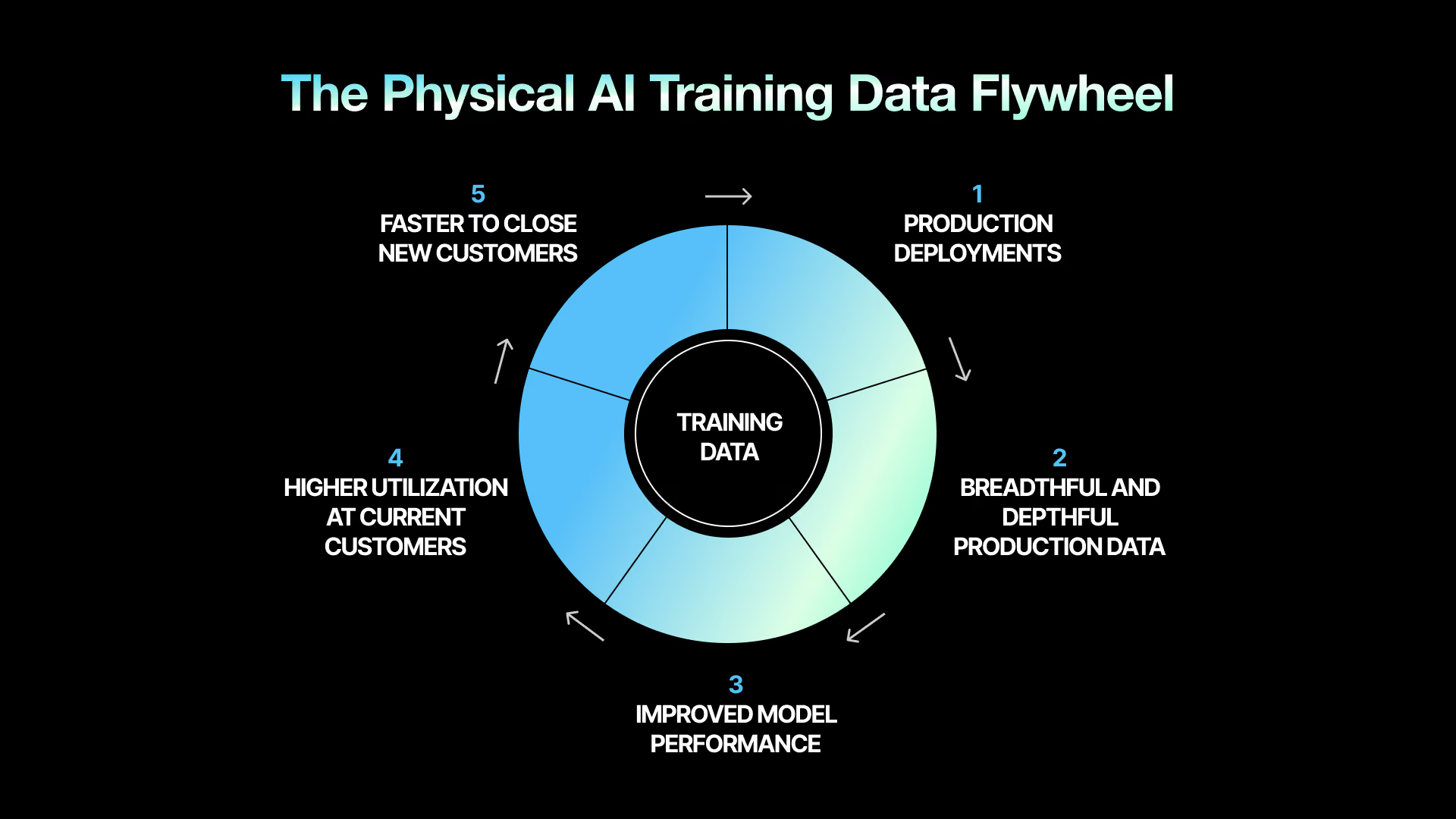
Chef robots have made more than 120 million servings in production, more than all other food robotics companies combined. Every serving a Chef robot makes generates data, which improves the next serving. We call this loop the data flywheel. It has been collecting data since our first deployment, and it compounds with every serving.
How the flywheel turns
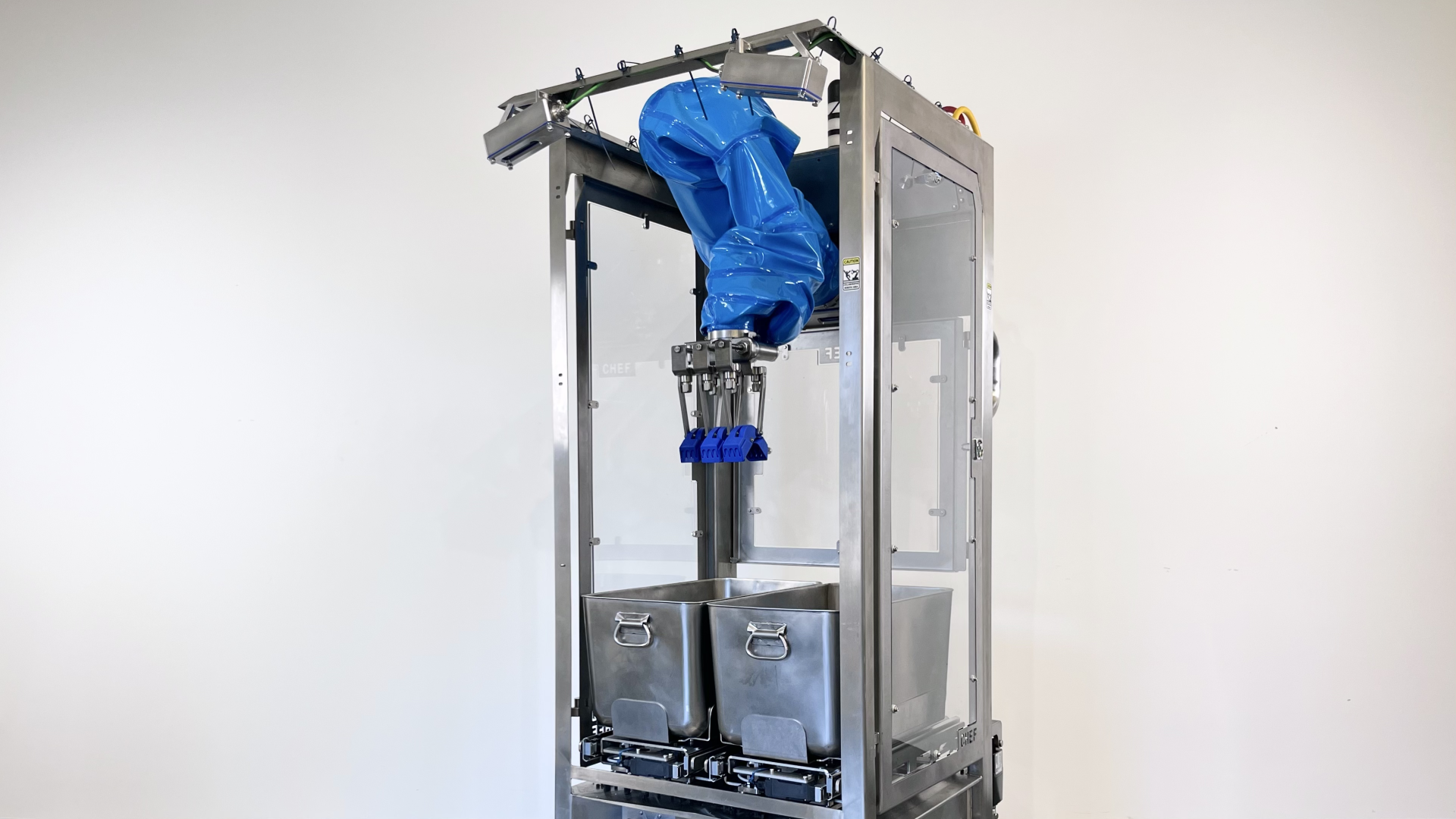
Every Chef robot that operates on a customer’s production line collects data each time it picks and places an ingredient. This data teaches the physical AI models that run the robot in the first place—models that detect trays, compartments, and inserts, models that portion scoopable ingredients or pick discrete items, and those that verify the quality of ingredient placement.
As the data grows, the same physical AI models can handle more ingredients, more tray types, and more edge cases over time, all on the same hardware. Customers see better performance in consistency, ingredient coverage, throughput, and placement accuracy on their production lines, and expand their use of additional Chef robots. We can handle new customers' ingredients from the get-go, so the time to close and bring up a new customer is faster. Every new robot on a production line and every new customer now adds even more production data, and the flywheel starts turning faster.
This loop also drives the development of our Food Foundation Model (FFM), the single end-to-end physical AI model that our AI research team is building to handle higher-complexity, lower-volume applications such as ghost kitchens and fast-casual restaurants. In a recent iteration of this loop on a burger assembly task, we added just 4.5% more training data, drawn entirely from the system’s own successful runs, and task success rose from 75% to 91.3%. A small amount of real data from the system’s own runs resulted in better performance than a much larger set of human demonstrations alone.
Chef robots learn from unreliable picks
The flywheel doesn’t only learn from what works. Chef robots record failed picks across pick position, depth, approach angle, and gripper twist, and use these records to steer away from unreliable pick poses before each pick. Every run a Chef robot completes makes its picks more reliable, because every failed pick teaches the models where not to go.
Why this data exists nowhere else
Unlike language, food manipulation has no internet-scale dataset. Ingredients are deformable, variable, wet, and sticky, and no corpus of such data is available for download. Simulation doesn’t capture it either. In our experience, production data matters far more than simulations, synthetic data, or lab data, because real production lines expose robots to the variability that ultimately determines performance.
The data Chef robots collect in production is also unusually diverse. Our robots perform high-mix meal assembly for more than a dozen customers across different countries, with many different ingredients, tray types, and SKU changeovers per line. Every shift generates varied data. Our models need that variety, not just more volume, to generalize.
Why the loop makes us even more differentiated and higher ROI for customers
The iterative training loop only works with production data, and that data exists only once a robot performs well enough to run on a real production line. That is the part no one can shortcut. Chef robots have been running our data flywheel since our first deployment with Amy’s Kitchen and have steadily expanded across nearly 20 facilities in the US, Canada, and Europe. A company that starts today will not convince customers to deploy dozens of robots from the get-go; they’ll start small and then scale up as Chef had to. Our flywheel is a few years ahead, so our customers see higher ROI and performance than customers who use that new upstart’s models.
Reliability compounds the same way data does. In food manufacturing, every minute of downtime translates into lost revenue. 60% reliability is interesting, but only 99% reliability is useful. Beyond 99%, every improvement becomes harder to achieve than the last and requires disproportionately more engineering, testing, and operational experience. That experience comes from the same place the data does: years of production.
The data flywheel also shortens ingredient onboarding times. SAGE, our AI-powered onboarding system, predicts manipulation parameters for new ingredients by referencing every ingredient Chef robots have run in production. As Chef robots produce more ingredients for more customers, this reference dataset grows, and SAGE’s predictions improve. Each new ingredient makes the next one faster to onboard.
What the flywheel is worth today
Chef’s customers have seen up to 88% less giveaway, 2-3x higher output, and 60% higher labor productivity. Newer customer sites reach full production speed faster than Chef’s earliest ones did, because they start from far more capable models on day one.
What’s next
Every production run adds more of exactly the data our models need. We also expect the flywheel to unlock new capabilities as the dataset grows. For example, the FFM may support zero-shot or few-shot ingredient onboarding, and adapt to new ingredients with minimal training data.
The flywheel’s long-term value extends beyond Chef robots. Our FFM, post-trained on one of the world’s largest food manipulation datasets, may ultimately be licensed across the food industry. Food requires specialized data, post-training, and domain expertise, and rather than recreating that infrastructure, other companies may build on top of Chef’s food intelligence layer.
If you’re a food manufacturer looking for flexible automation for your production lines, contact us to learn more about Chef robots.