

There’s a commonly held belief in Physical AI right now that if a robot can do any task, robotics is solved. The wisdom goes that if the industry solves task generalization, even if throughput is slow, you can just add more robots to make up the slower speeds per robot. What we’ve learned at Chef by deploying a lot of robots is that’s not totally true - throughput does matter, a lot, especially based on where you deploy the robot.
Task generality at home vs. domain generality in manufacturing
This approach to task generality can make sense in some environments (ultra-low volume and ultra-high mix), such as the home, where robots may need to move between many unrelated tasks and throughput matters less. In the home, to add value, you have to do a broad range of tasks (folding laundry, putting dishes in the dishwasher, making the bed), and each task takes a short period of time. Throughput also matters less; for example, at home, if folding laundry takes 30 minutes vs. 20 minutes, you don’t care much; task completion and task generalization matter more than throughput. If a task takes longer, the robot can still provide value.
But industrial applications have different requirements. Throughput is revenue - you are losing 33% of your revenue if the task takes 30 mins vs 20 mins. The whole idea in industrial applications is that at high volumes, jobs go from very generalized (the person at Chipotle is assembling burritos, cooking, cleaning bathrooms, and taking customer orders) to more specialized because of the volume (there’s a dedicated prep team, dedicated cook team, and dedicated assembly team). In other words, one worker does one task all day; industrial manufacturers need a superhuman robot per task, and they need an ROI to justify the activation energy and change management required to switch from a person to a robot.
For example, in food manufacturing, our robot doesn’t need to perform every task under the sun, especially if it regresses on the metrics they care about (throughput and reliability); rather, it needs domain generality: the ability to handle different ingredients, portions, trays, compartments, conveyors, and SKUs without sacrificing throughput or reliability.
For industrial robots, domain generality creates value only when the robot can maintain the throughput and reliability required to deliver ROI.
Why meal assembly depends on throughput
Some production equipment becomes more cost-efficient as its capacity increases. A larger oven or wider processing tunnel can add capacity without increasing equipment cost at the same rate.
In food manufacturing, high-mix meal assembly does not offer the same advantage. Each production line handles one meal at a time within a fixed footprint. The capacity can increase in two ways: the line can run faster, or the manufacturer can add more lines.
If one robot operates at half the throughput of the manual line it replaces, the manufacturer needs two robots to maintain the same output. Each additional robot requires space, energy, sanitation, and operator support. As a result, lower throughput increases the total cost of achieving the manufacturer’s production target.
How throughput affects RaaS economics and ROI
Chef deploys robots through a robotics-as-a-service (RaaS) pricing model. Instead of purchasing the equipment upfront, manufacturers pay an annual fee for each robot they deploy. This fee includes hardware, software updates, maintenance, upgrades, and support.
The manufacturer’s savings can be calculated as follows:
- Total annual automation cost = robots required x (annual RaaS fee per robot)
- Annual savings = annual manual line cost - total annual automation cost
As throughput falls, the manufacturer needs more robots to maintain the same output. This increases the total automation cost and reduces the manufacturer’s annual savings.
What metrics a manufacturer cares about:
In our experience deploying flexible robots, the metrics that most manufacturers care about are:
- Throughput
- Quality
- Yield
- Cost/labor savings
- Human safety
- And in the food industry, metrics adjacent to throughput include:
- Time to changeover
- Time to sanitize
- Domain generality
- Utilization
- All of the above translate to ROI - the ultimate deciding factor.
It's important to note how none of these are what tech stack the robot is using or if it’s a VLA or world action mode or an ensemble of models or a classical controls robot. What matters is the core manufacturing metrics.
The most important by far (outside of safety) is throughput. Throughput is revenue.
Our learning has been that to justify the change management (and risk) to deploy a robot and make it worth it for the manufacturers, while at the same time one of two preconditions must be true:
- Your throughput has to be superhuman
- If your throughput is at parity, you have to be superhuman in another one of the metrics (like yield or quality).
Otherwise, manufacturers would ask, “What’s the point?” Why go through this whole exercise if there’s no ROI? Manufacturers always have fifty projects with ROI; many are operational, like a better ERP or a process optimization change. So you’re competing for their mindshare, and they’ll only move forward with your robotics proposal if it’s in the top three for ROI.
Can a robot compensate for lower throughput by working longer hours?
A robot can sometimes offset a lower hourly rate by operating more hours. For example, if a manual line runs for 2,000 hours per year and a robot runs for 6,000 hours, a robot with one-third of the hourly throughput could deliver the same annual output.
However, this only works when the facility has unused production time. Many food manufacturers already run two production shifts followed by a required sanitation window. The shelf-life and cold-storage requirements of the meals also limit when they can be produced and assembled. In these facilities, extra operating hours can’t fully offset a slower robot.
It’s important to note that assembly is just one part of a food operation. Many other tasks exist, from cooking/kitchen to prep, material handling, refilling, heavy lifting, and more. There’s a fixed cost per hour to run the plant; the ROI doesn’t work if you have to pay for all those other workers to run the assembly line longer.
The essence of space for almost every plant
There are two high-level models around deploying robots:
- Build the space around the robot.
- Put robots into an existing space.
The former is, for example, how Amazon Robotics or AutoStore works: they build the plant around the robots. This works great for a giant like Amazon (where you have access to cheap capital to build new sites) or a manufacturer building greenfield plants. But how many “greenfield” (new) plants are built in America every year? Not a ton.
The vast majority of sites are “brownfield” or existing sites that humans have worked in for years. And in these sites, assembly lines are built for humans and for human footprints (~36”). So, the space is immensely tight.
If you need 72” to do the work that a human can do in 36”, your TAM becomes immensely limited. Now, will someone do a pilot/demo/POC? Sure. But to run production and show the customer ROI, you need to match a human's “output per conveyor width” just to fit through the door.
The fixed cost basis of robots
For most robots, the arm itself is <50% of the bill of materials (BOM). There’s a fixed cost base for the robots. 3 robots are 3x the cost. So now, if you need two or three robots to do the work of one person, your unit economics and margins are extremely slim.
Again, it’s possible to do this for a demo/POC, but to actually deploy and scale, the economics are unfeasible. And even if you make the economics feasible, there’s no space to deploy multiple robots that do the same work as one person.
Other factors that affect a production robot’s ROI
Throughput, space, and fixed cost aren’t the only factors that determine ROI in robotics. Other factors include low energy use, simple sanitation, and minimal worker support. When evaluating production robotics, manufacturers should compare the total cost of achieving their required output, including how many robots they need and the resources required to operate them.
As an example, let’s assume a manufacturer needs 3 robots to make up for the throughput of one person:
- Now he has 3x the number of pans to refill and robots to manage. The one refill runner/replenisher cannot keep up, and he needs to add another refill runner to keep up with all the robots. So this gives closer to 4:1, which is a negative ROI.
- The manufacturer will also have 3x as many robots to sanitize between changeovers. This means that now the lines are down more between changeovers. For a high-mix food manufacturing plant with 15+ changeovers per line per day, that means millions of dollars in lost revenue. Idle lines lose money just the same way that airplanes that are not in the air lose money.
High-throughput meal assembly with Chef robots
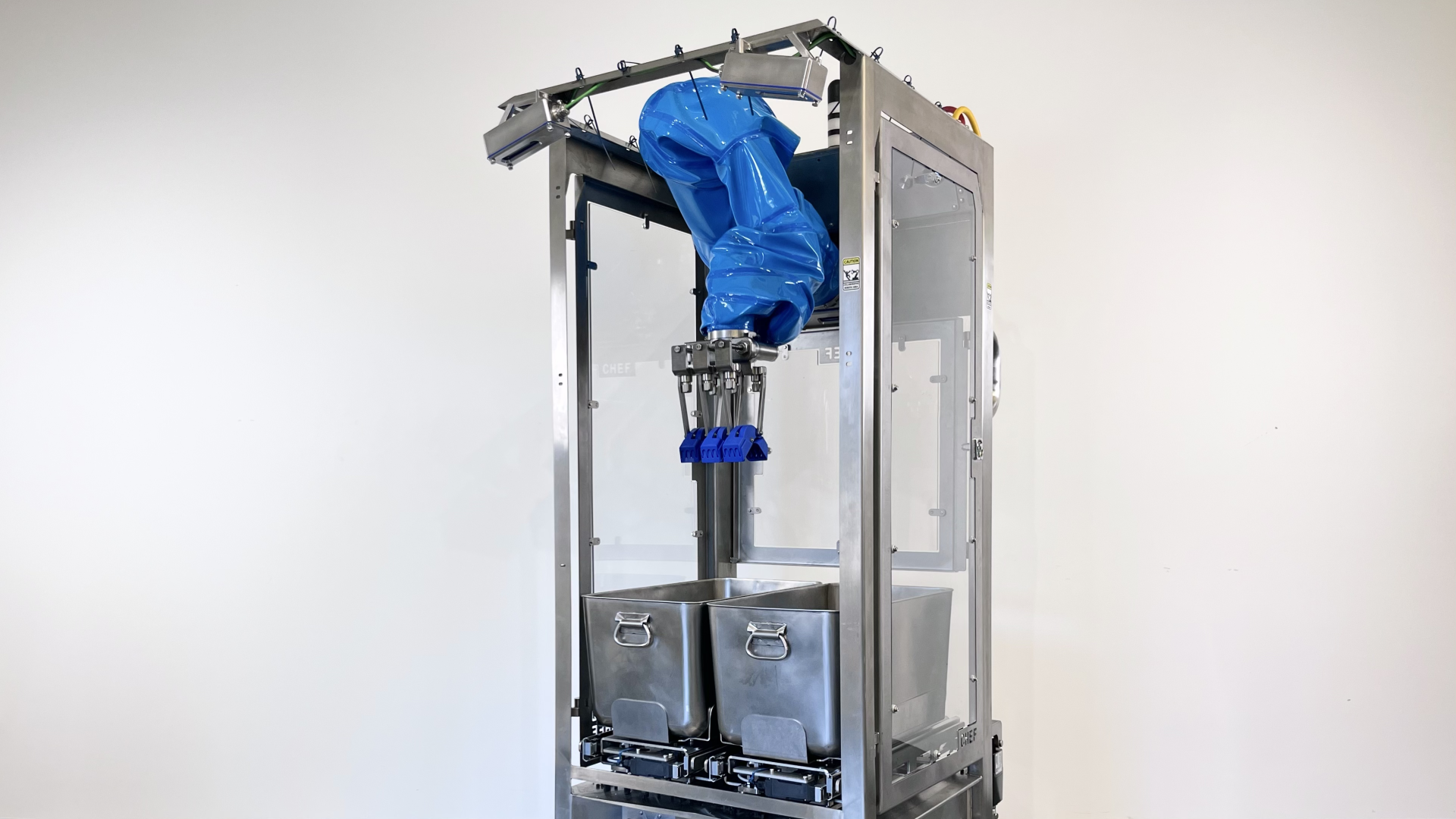
Chef robots are designed to operate at production speed on existing high-mix meal assembly lines. They track trays on moving conveyors, adapt to changes in conveyor speed and tray position, and coordinate with other Chef robots on high-speed lines.
Chef robots have completed more than 140 million servings in production, and customers have increased output by 2-3x after deploying our robots. This production experience lets us continue improving throughput, reliability, and performance across different ingredients, meals, and production environments.
If you’re a food manufacturer looking to increase production capacity with AI-enabled robotics, contact our team to learn how Chef robots can fit into your production line.

.png)