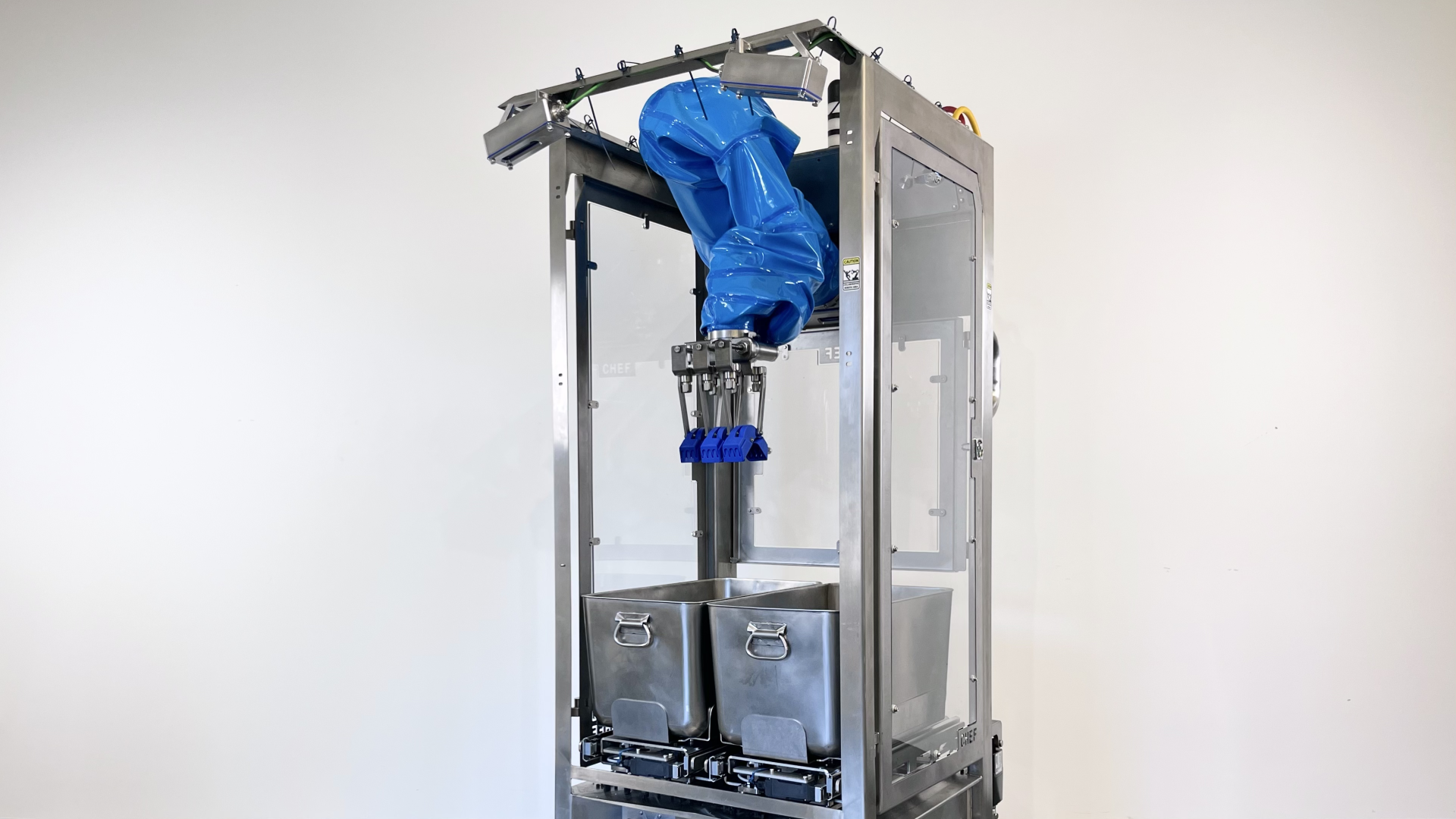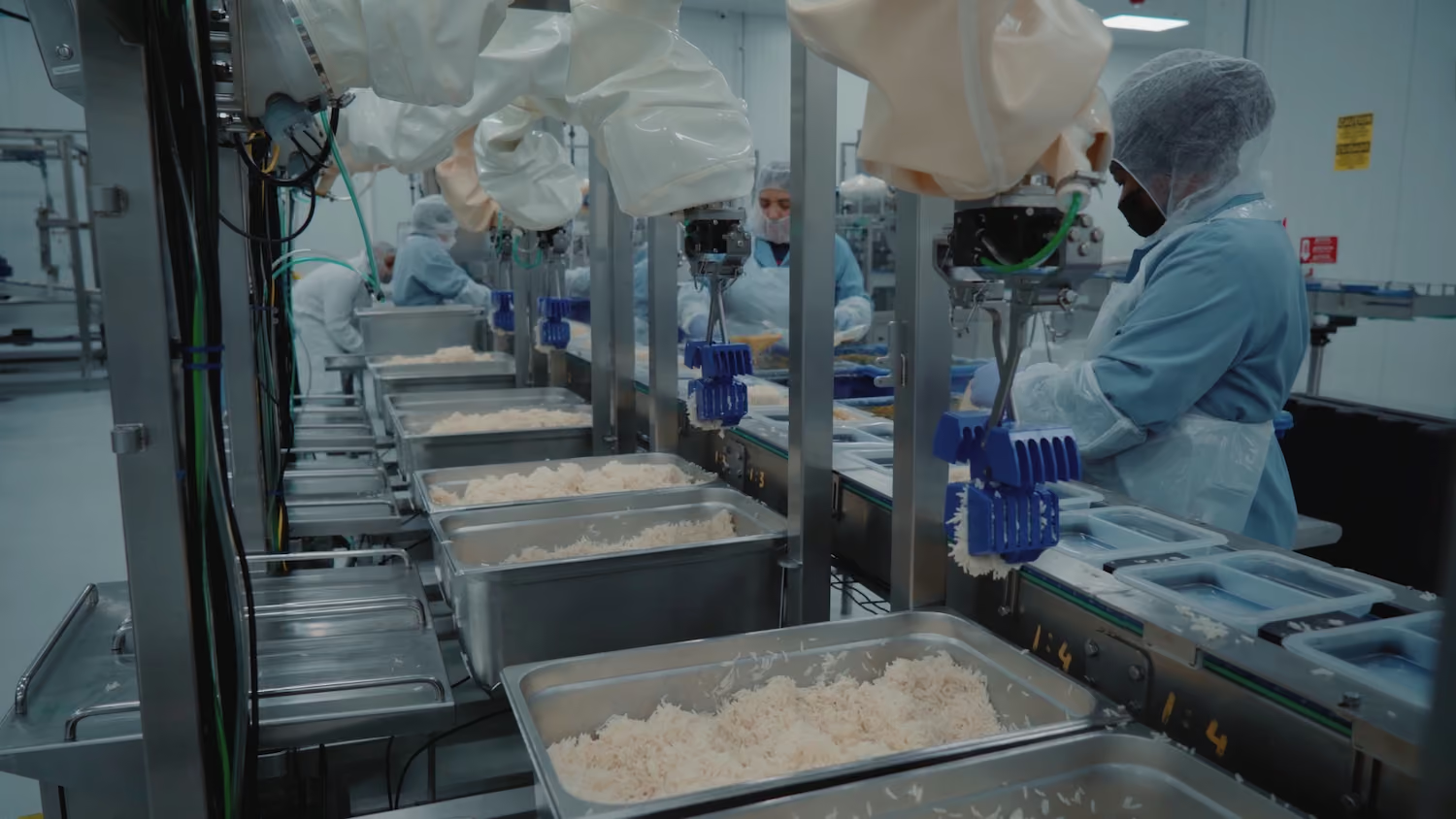
Throughput is an important metric for most food manufacturers, who often run high-speed meal assembly lines. Chef robots are designed to match the speed of a worker while maintaining consistent deposits, thus providing a solution that can partially automate a line without retrofitting.
To achieve higher throughput—and in cases where multiple workers serve the same ingredient on the same line—many Chef customers deploy multiple robots serving that ingredient on a shared conveyor line. What started out as a one-robot job (scooping and depositing food into trays) now becomes a communication problem: how can two or more robots observe a conveyor’s speed and start/stop behavior, agree on tray positions and orientations, and decide which robot should deposit food into which tray (i.e., to prevent two robots from placing into the same tray), all while maintaining high throughput and precision?
Different approaches to achieving high throughput
We explored several approaches to solve this communication challenge.
One involved per-ingredient computer vision classifiers. Specifically, in addition to the detector to determine the position and orientation of a tray, we trained a classifier to determine whether a tray already contains a certain ingredient, but food manufacturing involves thousands of ingredients, making this difficult to scale.
Another approach used pan-and-tray similarity models to infer whether the ingredient in the pan had already been placed in the bowl, but this required large amounts of data and relied heavily on imperfect visual feedback. This was challenging to deploy at high speeds in real-world production environments and also didn’t work for some ingredients (e.g., if previously placed ingredients in the tray looked like the “new” ingredient in the pan, the robot wouldn’t place).
We also experimented with operational approaches, such as offset tray positioning, where trays were placed slightly closer to or farther from a robot, and color-coded conveyor patches, in which robots targeted trays according to specific markings on a conveyor belt. These all had their own limitations.
Eventually, we concluded that robot-to-robot communication was the most reliable and flexible approach.
What is robot-to-robot communication?
Chef is not the first company to utilize robot-to-robot (R2R) communication technology. Automotive assembly lines and warehouses are just some of the industries that have been using this technology for years. R2R communication describes any direct exchange of data between robotic systems without human intervention. Rather than each robot acting independently, R2R-enabled robots share information in real time and behave as a coordinated system rather than a collection of individual machines. The underlying technology that enables this communication depends on the use case and ranges from wired Ethernet to Wi-Fi and middleware frameworks like ROS.
How Chef’s R2R communication works
Chef’s R2R communication is powered by wireless radios, allowing our robots to communicate independently of wires (which lack flexibility) and Wi-Fi (which can experience outages). Each Chef robot contains a built-in wireless radio to receive a real-time feed of tray positions and orientations on the conveyor. When the first robot deposits an ingredient into a tray, it immediately shares that data with the next robot downstream. The second robot then knows exactly which tray to target and when to make its deposit.
Since each Chef robot still runs its own perception system, all robots remain independent and robust to real-world variability. While the R2R communication layer keeps Chef robots synchronized as trays move down the line, each robot’s perception system continues to track tray positions and orientations in real time, providing an additional layer of verification before each deposit.
Benefits of Chef’s R2R communication
- Easy to deploy without changing existing lines: Chef’s R2R communication runs over a wireless radio and requires no additional infrastructure, allowing manufacturers to quickly add robots to existing production lines.
- Works across all ingredients: Since this capability relies on tray tracking rather than food recognition, manufacturers can automate a wide range of meals and ingredients without needing ingredient-specific models.
- Ensures faster reactions on high-speed conveyors: Receiving tray trajectory data from the upstream robot allows the next robot to react faster on fast-moving conveyors, helping increase throughput on high-speed lines.
- Reduces spillage and missed trays: Robots stay aligned on which trays to fill, preventing duplicate deposits or skipped trays.
- Scales on existing lines: With R2R communication in place, food manufacturers, if required, can add an additional Chef robot to an existing line and increase throughput without requiring complex infrastructure. This allows production teams to quickly fill capacity when demand rises.
- Maximizes throughput: In some configurations, Chef robots can reach speeds of up to 150 trays per minute, enabling production lines to maintain extremely high throughput while ensuring consistent ingredient placement.
If you’re running high-speed meal assembly lines and exploring robotic automation for food manufacturing, get in touch with our team.