%20copy%202.avif)
Can you automate baked goods packing? It's one of the most common questions we get. Today, the answer is yes. Chef robots can now flexibly automate tray assembly for baked goods packaging, placing discrete items such as burger buns, chocolate chip cookies, biscotti, butter cookies, biscuits, fortune cookies, granola bars, rusks, and shortbreads into trays and packaging containers before sealing.
But isn’t baked good assembly already automated? What we’ve learned is that in low-mix manufacturing operations, manufacturers have been able to get fixed and custom automation that works for one SKU; they build something that can handle that one ingredient, but it’s not flexible enough to work with other SKUs.
But in high-mix operations, with frequent changeovers, these kinds of traditional automation don’t work.
In addition, baked goods pose a unique challenge for food manufacturing automation. Each item behaves differently on the production line—a granola bar can compress under the wrong grip, while a biscotti or rusk can crack if placed at the wrong angle. Surface textures range from glazed and smooth to crumbly and irregular, and most baked goods have strict presentation requirements. Getting all of this right, consistently, at production speed has kept baked goods packaging largely manual.
How Chef’s physical AI models handle baked goods packing
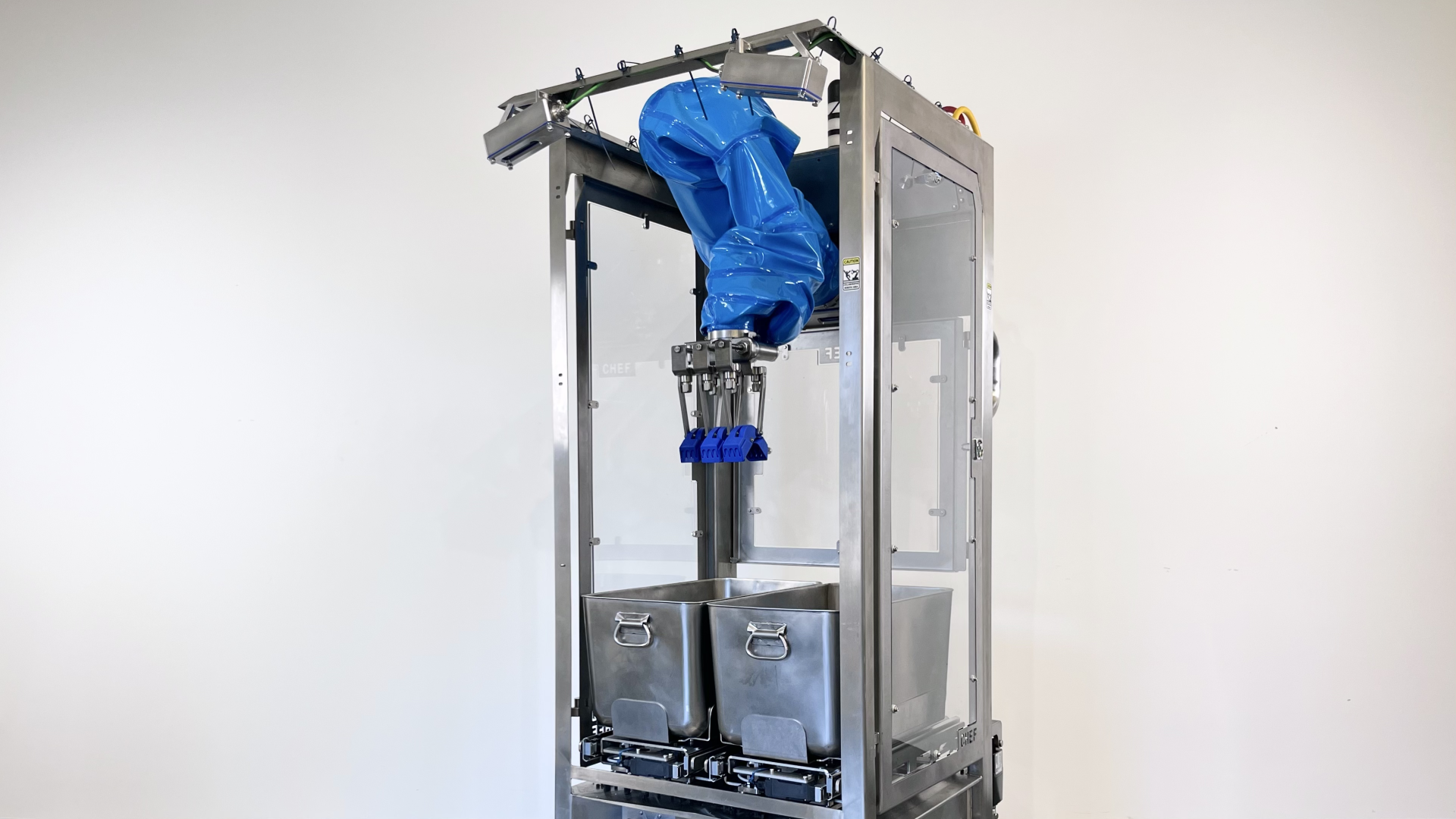
Chef robots handle baked goods packaging using the existing piece-picking capability. Using AI-powered computer vision, Chef robots assess each item’s position, shape, and orientation in real time to quickly and precisely pick it up and place it into the tray or packaging container without damaging it. The capability is built on physical AI models trained across diverse real-world production environments, allowing Chef robots to adapt to how baked goods sit in the pan without any pre-sorting or fixed pan placement required.
The piece-picking capability uses a custom-designed, food-safe, vacuum-powered utensil with multiple quick-change attachments for different types of items. This includes firmer items like biscotti and rusks, as well as softer, more delicate items like butter cookies and granola bars, ensuring careful handling across the full range of baked goods.
Four AI-powered placement capabilities for baked goods packing
Packing baked goods requires more than picking and placing items into a tray. Depending on the SKU, Chef robots provide four distinct placement capabilities:
- Precise angular placement: Retail baked goods packing often requires each item to land in a specific orientation to maximize space efficiency, visual consistency, and shelf appeal. Chef’s vision system detects the angle at which each item sits in the pan and reorients it after picking, ensuring it arrives on the tray at the exact angle required, regardless of its position in the pan. For example, some SKUs require burger buns to be placed flat side down, or shortbreads to be arranged at a uniform angle to maximize pack density.
- Multi-item tray assembly: Chef robots can place multiple baked goods into the same packaging container in a single automated pass, completing full tray assembly without any manual intervention between picks.
- Compartment placement: For packaging containers with multiple small compartments, Chef robots can precisely place baked goods into each designated section, including multiple items in the same compartment. Chef’s AI vision model detects the position and orientation of each compartment in real time and adjusts placement accordingly, ensuring each compartment is filled with the correct number of items without spilling into adjacent compartments.
- Offset placement: Chef’s vision system identifies the exact center of each tray and uses it as a reference point for every deposit. Each item is placed at a predefined offset from that center. For example, in a three-cookie pack, the robot places the first item at the center, the second 5cm to the left, and the third 5cm to the right. As a result, every pack looks the same, regardless of how trays arrive on the conveyor.
-
What this means for food manufacturers
Baked goods packing lines have traditionally relied on manual labor—work that is repetitive, physically demanding, and difficult to staff consistently, especially given the care required when handling fragile items. Chef’s baked goods packing capability offers food manufacturers higher throughput, lower labor dependency, and consistent presentation across shifts. The capability runs on Chef’s existing robotic hardware and software, allowing food manufacturers to deploy it without changing their production line infrastructure.
What’s next
For food manufacturers evaluating bakery equipment, bakery machines, and bakery systems, Chef’s robotics-as-a-service (RaaS) model makes it straightforward to get started.
Interested in learning more about Chef’s capabilities? Contact us to discover the full range of applications our robots are running for industry-leading food manufacturers.