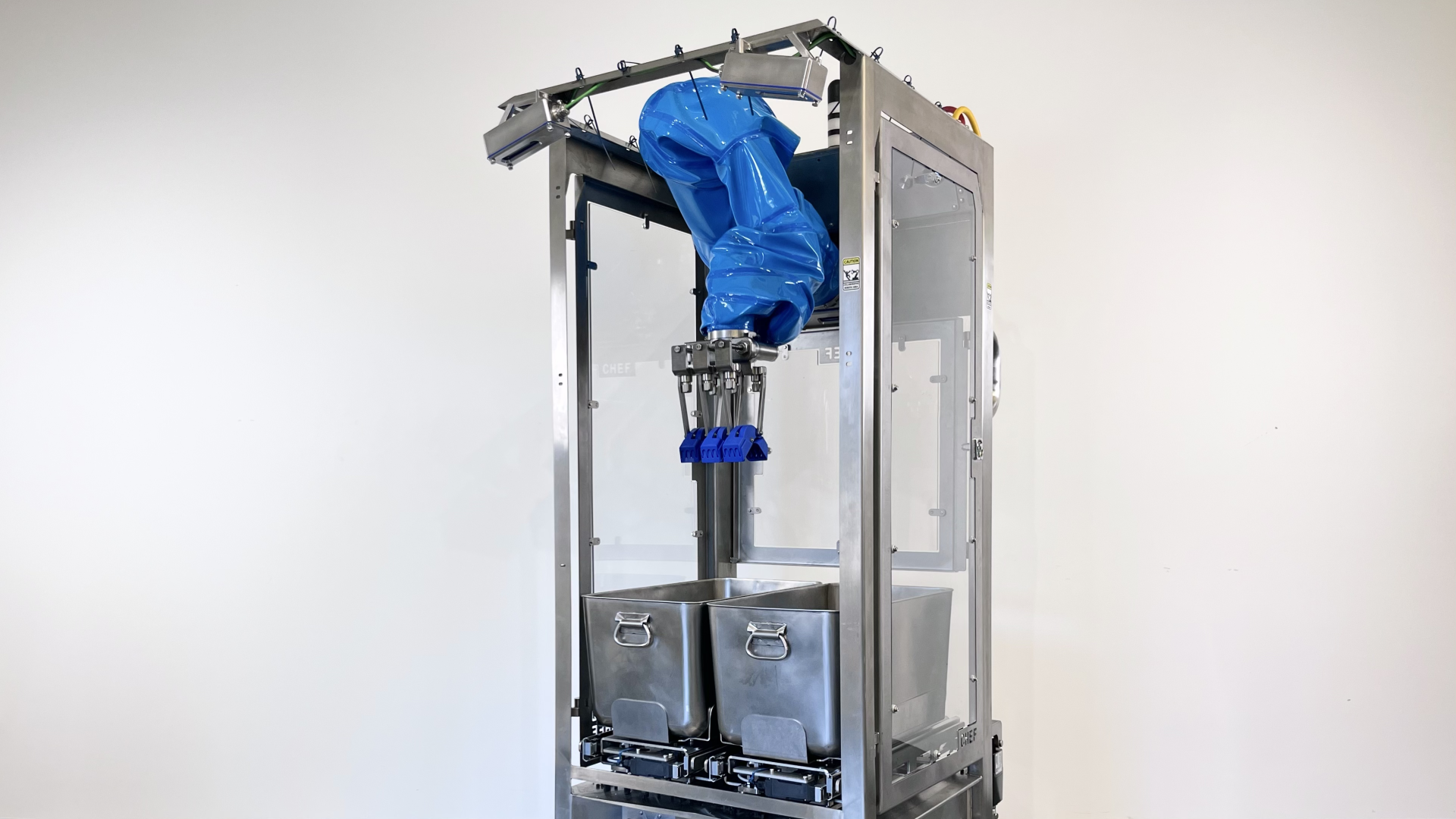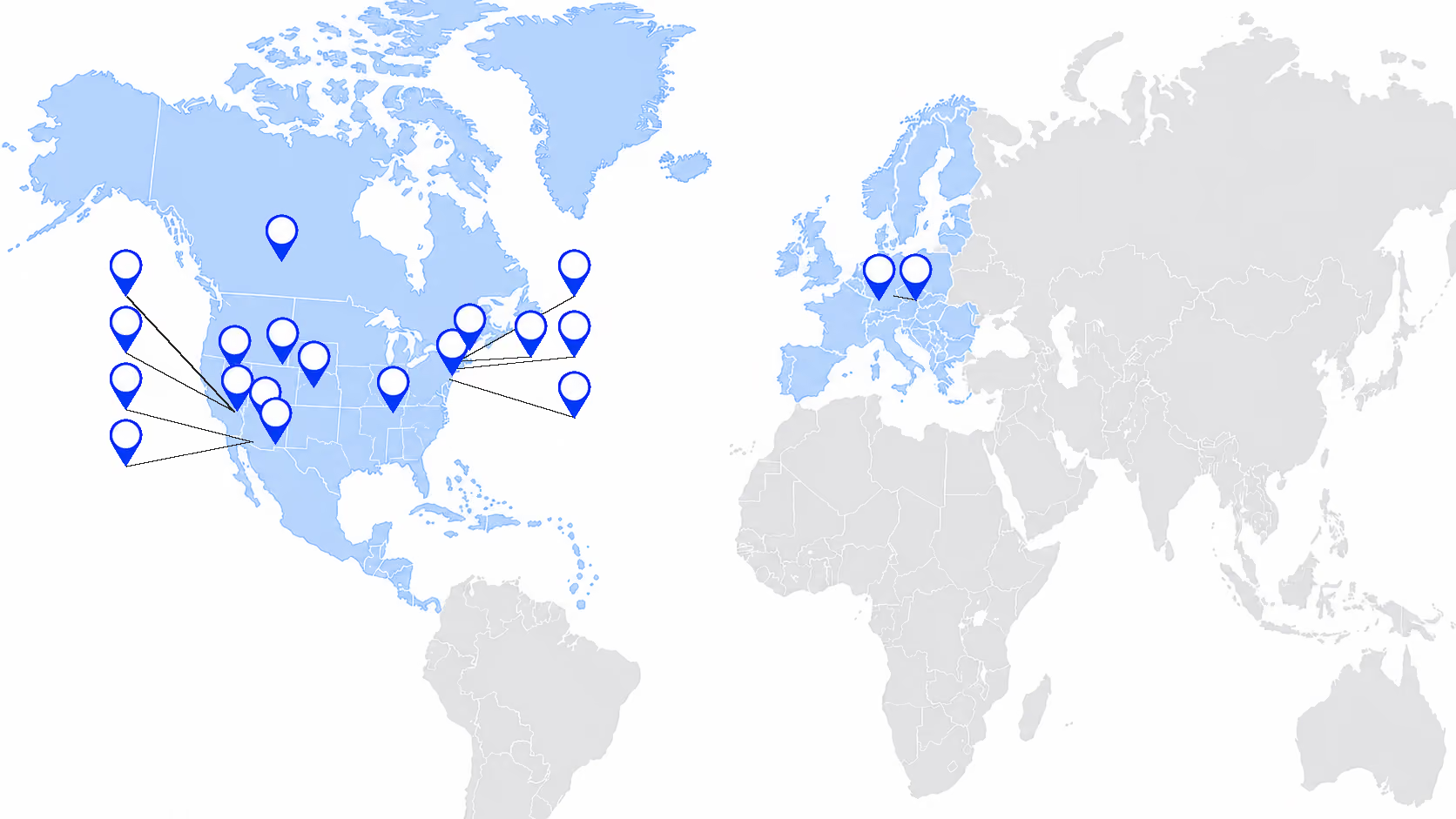
Chef robots run in production across North America and Europe. Each robot needs to stay up and running, get fixed fast when something goes wrong, and keep improving over time, regardless of the time zone. This blog covers how our support team keeps robots running reliably at scale in production, and what had to change as our fleet grew from a handful of robots in the US to dozens across two continents.
Why a growing fleet of robots across different countries gets exponentially harder to support
Supporting one robot in one country is simple. A support engineer can visit the site, working hours mostly overlap, and most issues get resolved during the day.
Deploying robots across more countries brings many operational challenges. The first challenge is coverage. A robot in Europe can go down while the US team is asleep. Real customer support means round-the-clock coverage across every time zone Chef operates in.
The second problem is diagnosis. Chef robots combine hardware and software running together. When something breaks, an engineer isn’t just debugging code but often diagnosing physical wear on a real machine, on top of the usual software problems.
The third problem with deploying robots globally is reach: getting the right spare part (or the right person) to the robot. Spare parts crossing international borders take longer to arrive, and finding certified technicians nearby on time is hard, too. On top of that, communicating with facility teams who speak a different language adds friction.
How Chef keeps robots running across two continents at scale
Keeping a global fleet of robots running comes down to four layers of support, from most automated to most manual: autonomous self-resolution, proactive customer notification, 24/7 remote support, and a scalable field response model for hardware.
The first layer is the robot fixing itself. We build autonomous software that detects operational issues and resolves them without a person in the loop. For example, we used to see cases where, when a conveyor was physically shifted, the robot could no longer see the trays in the location it needed to place ingredients, and it would stop placing them correctly, leading to a 4 AM support call. Now our autonomy software catches these issues and corrects them automatically, without requiring a call. We also run a tight bug-and-triage process behind the scenes to keep expanding what the robot can resolve on its own. We've seen hundreds of similar situations, and in each one, we quickly figure out what went wrong and build autonomy software that lets the autonomy stack self-resolve the issue in the future.
The second layer is proactive notification. When the robot can’t resolve something itself, the second layer is that our autonomy software notices that there’s an issue and we notify the user via the HMI about the issue; for example, if the conveyor speed is set too high, while the robot cannot self-resolve, we can at least notify the user and let them solve the issue. If the HMI and notifications are not sufficient, we have also developed a customer knowledge base in our customer portal that uses AI to help users identify common resolutions in setup and operations based on that developed knowledge base.
The third layer is 24/7 remote support. At Chef, customer requests flow into an integrated portal for initial triage, staffed around the clock so coverage doesn’t depend on time zone. At that stage, the team resolves questions and issues beyond what the portal’s knowledge base covers, while higher-complexity technical cases escalate directly to Chef’s support engineers. Customers can also page us 24/7 via PagerDuty for urgent issues.
We have invested heavily in data pipelines and data infrastructure to retrieve field data and access telemetry and rolling-record ROS bag data to resolve issues as they come up. Our support engineers use tools like Foxglove alongside in-house tools to run real-time diagnostics. These tools allow our team to debug and analyze data on a live system that operates thousands of miles away.
The fourth layer is hardware break-fix. When hardware needs physical attention, we rely on a network of certified third-party technicians. These technicians handle routine maintenance, sensor swaps, and on-site mechanical repairs. For larger milestones, like integrating a Chef robot with a facility’s unique conveyor system or onboarding a challenging meal profile, Chef’s support engineers travel on-site to handle it in person.
Lastly, our support engineers don’t just fix what’s broken. They trace issues back to their root cause across the entire fleet, not just the robot behind the ticket. That allows us to do two things: preventative maintenance based on incoming data, and software updates that improve performance, informed by thousands of deposits in our fleet records every week.
Similarly, reliability starts in R&D. We have a culture of testing and hardening our software and running it through batteries of tests, whether SIL, HIL, or automated unit and integration tests, to catch issues before the software gets to the field. After that, we carefully release software site by site to minimize the blast radius of new software.
Why customers expand their fleets after deploying Chef
The clearest measure of a support model’s success is customer satisfaction, and ultimately, expansion. Customer happiness gates growth, and when existing customers expand their deployments, it proves that the model builds operational trust.
We’ve seen customers scale fast. One customer grew from 2 robots to 36. Another went from 2 to 22. That kind of expansion only happens when a customer trusts the model enough to bet more of their production line on it. Behind the scenes, urgent escalations to engineering need to stay low. Today, fewer than 5% of support cases escalate to engineering, leaving the core engineering team free to build without disruption.
Our support team’s headcount shows this, too: it’s growing sublinearly relative to the number of robots deployed and customers. Upfront triage, remote diagnostics, and our field technician network keep our support team lean as Chef’s global footprint grows across more countries.
If you’re considering how to scale food automation across North America or Europe, get in touch with our team.