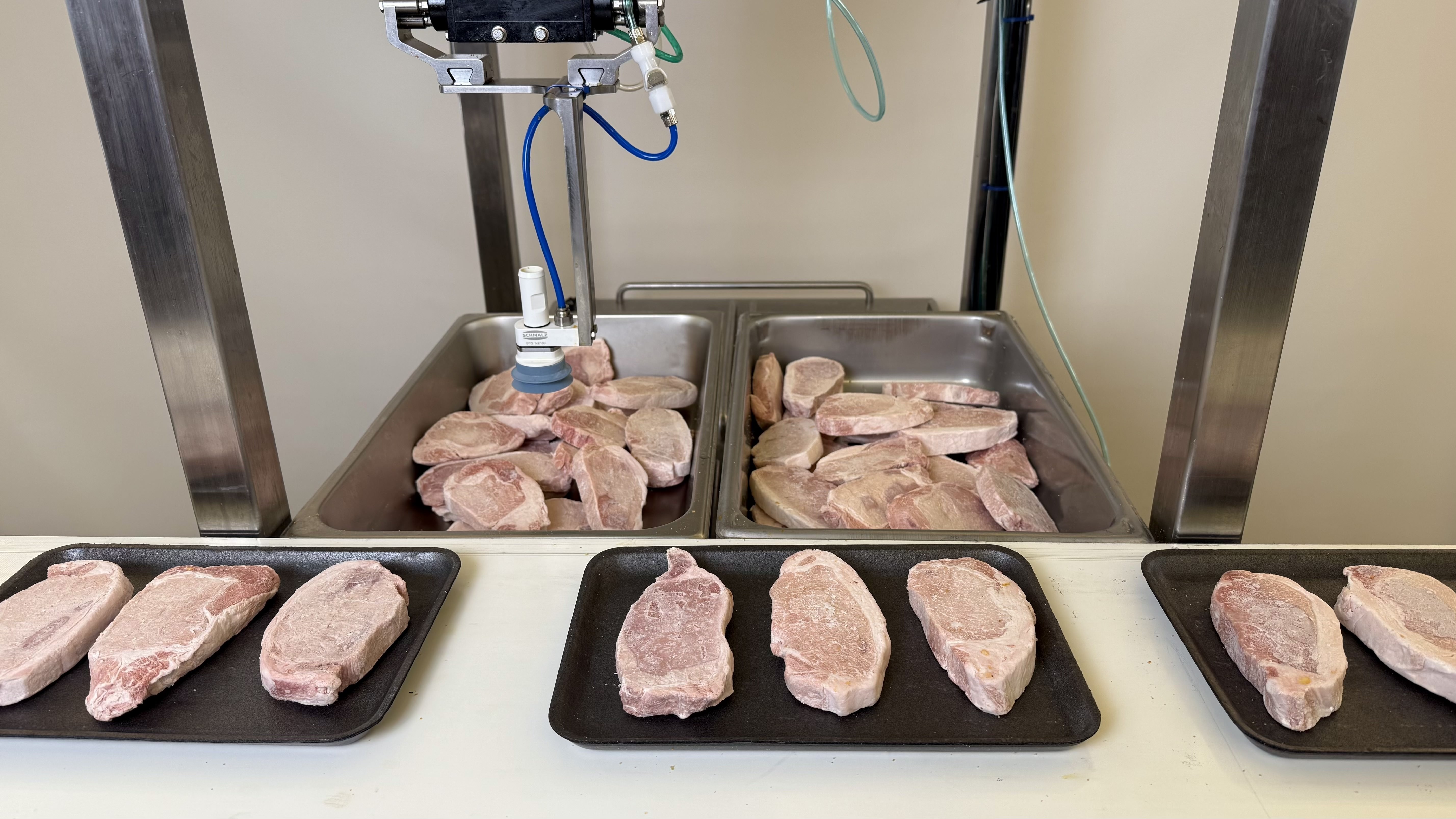
We are excited to share that Chef’s Physical AI models and robots can now help automate tray assembly for meatpacking tasks by assembling pieces of meat into trays before packaging. These include raw, frozen, and precooked proteins such as pork loin filets, chicken breasts, steaks, lamb chops, bratwursts, and sausage links.
Meatpacking tasks in high-mix food manufacturing facilities have historically been difficult to automate. Unlike sauces, grains, or chopped vegetables, pieces of meat are irregular, deformable, and highly variable in size. Each piece differs in shape, weight, surface texture, and stiffness depending on the cut and whether it is raw, frozen, or precooked—a frozen chicken breast behaves differently from a fresh pork loin. This variability has made it challenging for automation systems to handle proteins reliably at production speeds.
How Chef robots handle meatpacking
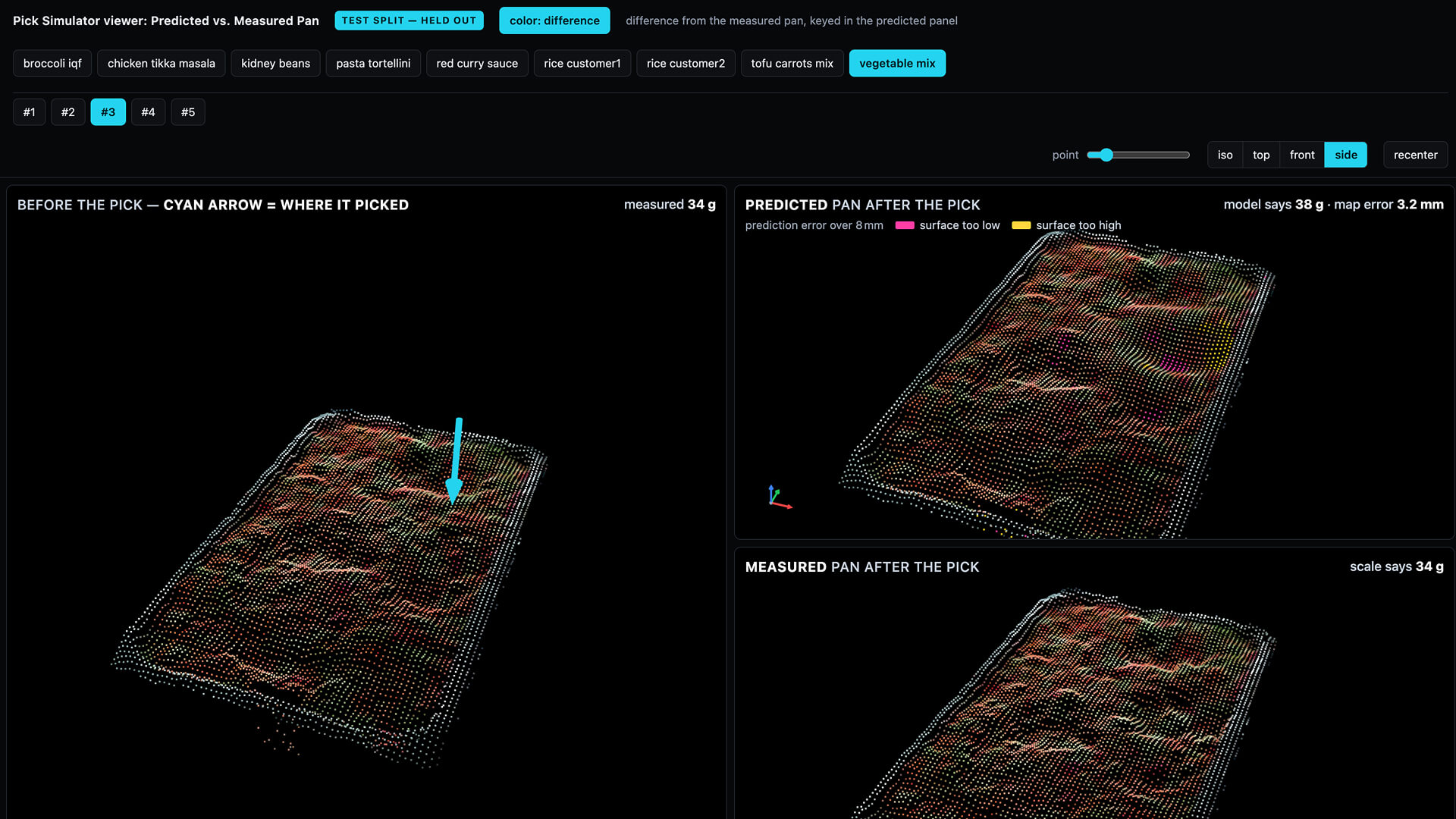
Chef robots complete meatpacking applications using the existing piece-picking capability. This capability utilizes Chef’s AI and computer vision system and is trained on large volumes of data covering the visual appearance, physical properties, and handling characteristics of different protein types. This enables Chef robots to make real-time decisions about how to grasp each piece of meat and where to place it into a tray.
Three AI-powered placement capabilities for the meatpacking application
To enable our robots to handle meatpacking tasks, we introduced three distinct capabilities that go beyond our standard piece-picking capability:
- Precise angular placement: Meatpacking facilities often require pieces of meat to be placed in a specific location and orientation within a tray, both for space and presentation. Chef’s vision system detects the angle at which each piece of meat sits in the pan and reorients itself after picking it up in order to place it at the exact angle required on the tray. This means the robot is not constrained by the orientation of each piece in the pan; it adapts to each pick and places every piece in the correct orientation. For example, some SKUs require pieces of meat to be placed at a 90-degree angle to the tray to achieve a consistent, retail-ready presentation.
- Multi-item tray assembly: Chef robots can place multiple meat pieces into the same tray during a single automated pass, automating the entire tray assembly without manual intervention.
- Offset placement: Chef’s vision system identifies the tray’s center and calculates predefined offsets for each piece. For example, when placing three pieces of meat into a tray, the robot places the first piece two inches to the left of the center, the second right at the center, and the third two inches to the right, ensuring consistent spacing and an even arrangement across every tray.
What this means for food manufacturers
Tray assembly for meatpacking tasks has traditionally required manual labor—work that is physically demanding, repetitive, and difficult to staff consistently. Chef’s meatpacking capability offers food manufacturers higher throughput, lower labor dependency, and consistent portion presentation without requiring changes to existing production line infrastructure.
What’s next
As a next step, Chef is working on increasing throughput for meatpacking while also maintaining a collaborative environment and robot.
Interested in learning more about Chef’s capabilities? Contact us to discover the full range of applications our robots are running for food industry leading manufacturers.