There’s a major debate in physical AI right now: will generalist models and embodiments outperform vertically integrated solutions? We don’t think this is an either-or question. Both approaches will create enormous value. But for companies building today, the path to market looks very different for each. In our view, intelligence will become increasingly shared, while embodiments will remain highly specialized. Here’s why.
Two forces: embodiment and intelligence
The argument for generalist vs. verticalized physical AI depends on two core forces:
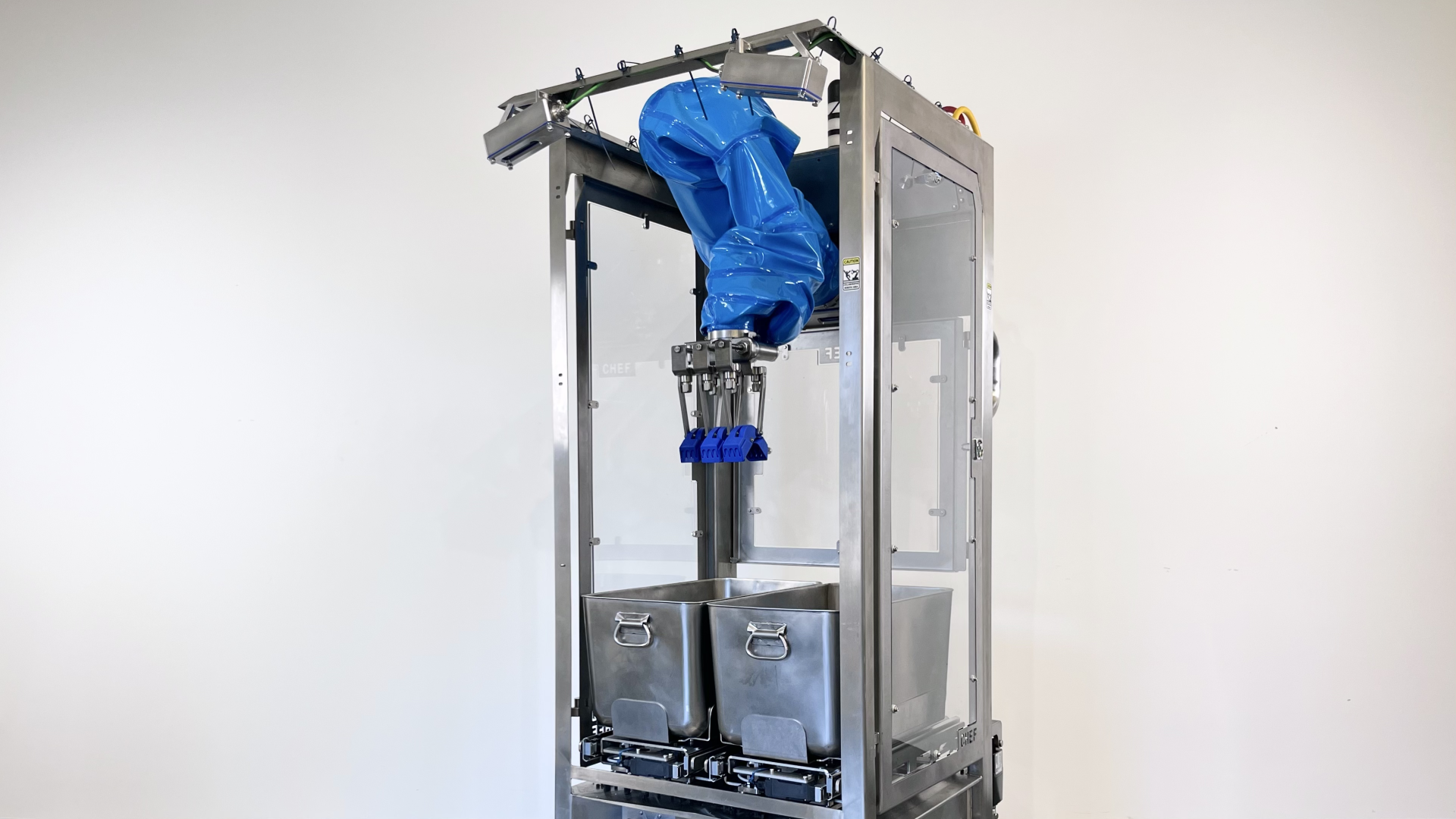
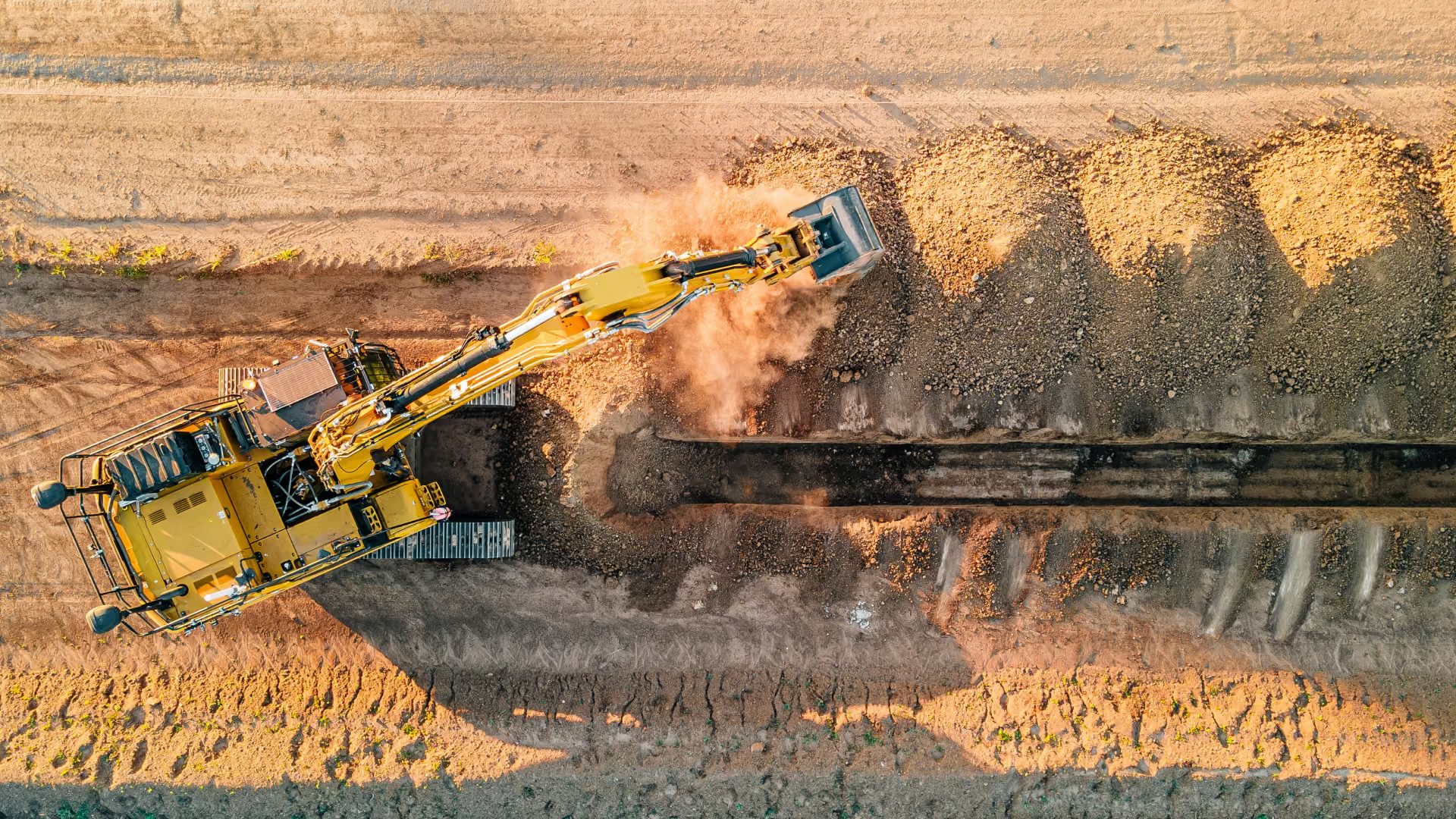
- Embodiment: one general form factor (e.g., a humanoid) vs. hardware purpose-built for a job (e.g., an excavator, a palletizer, a food assembly robot)
- Intelligence: one general model that can complete any task vs. a model specialized for a specific domain
The strongest arguments for verticalization are generally based on embodiment, and the strongest arguments for generalization usually rely on intelligence. A generalist would most likely concede that one shouldn’t put legs on a palletizer; their bet is that the intelligence converges and transfers across tasks.
Our view is that embodiment should be verticalized, but a base AI model can be shared. The winning vertical stack in any industrial market is purpose-built hardware running on a strong pre-trained base model that’s been post-trained on proprietary, domain-specific data.
General-purpose robots make sense in the home
A general-purpose robot makes sense when a few preconditions hold:
- High task diversity: you need to complete a large variety of tasks
- Low task duration: each task is relatively quick to complete
- Low throughput requirements: speed is not a primary driver of the economics
- Low cost of imperfection: occasional errors are acceptable and easy to recover from
Based on these preconditions, the home is the archetypal use case for a general-purpose robot. The home use case requires physical AI that performs well enough at a wide variety of tasks:
- You need to complete a wide range of tasks (e.g., loading the dishwasher, vacuuming the floor, doing laundry)
- The duration of each task is short, taking about 15 minutes to complete
- Throughput is not that important (e.g., if 15 minutes’ worth of laundry folding takes a robot 25 minutes to complete, that’s still a net positive for the customer who doesn’t need to fold their laundry anymore)
- If the robot doesn’t complete one task perfectly, that’s okay (e.g., a home robot’s mistake might result in a dirty plate sitting in your kitchen sink, while in an industrial setting, one small mistake can lead to thousands of product recalls)
A note on safety
It’s worth noting that the home probably has the highest safety bar of any robotics environment. Home robots operate around children, seniors, and pets, often in spaces where people are relaxing, distracted, or simply going about their daily lives, not paying close attention as they would in a factory or warehouse.
So it’s not that the home is “easy.” The home is forgiving on throughput and task completion, but it isn’t forgiving on safety. A household robot can be slower or occasionally fail to complete a task, but it can’t be unsafe.
In that sense, even if a general-purpose embodiment is ultimately the right form factor for the home, the home is the final boss of robotics. That’s one reason so much capital is flowing into the space today, much like what happened with autonomous vehicles.
Vertical integration wins in industrial use cases
Unlike the home, business-to-business (B2B) industrial use cases (e.g., food, manufacturing, supply chain, logistics, agriculture, medical, construction, retail) demand the opposite:
Low task diversity, long task duration
Industrial use cases require robots to perform more or less one task over an entire shift. Naturally, customers will want something that performs extremely well at that one task. For example, on a food assembly line, you’d want a robot that’s extremely competent at portioning and plating any food ingredient into any type of tray or bowl. You don’t need that robot to also be great at chopping and cooking food, and you certainly don’t need it to be good at folding laundry. This example holds true for most industrial use cases. You don’t need your palletizing robot to be a good forklift driver, too.
Customers buy ROI, not versatility
“Low diversity, long duration” means that customers want a superhuman that’s good at one job. In industrial environments, the goal isn’t to deploy a 1:1 human equivalent; it’s to provide a return on investment (ROI) relative to labor. This ROI is only possible with superhuman performance, not equal-to-human performance or, more realistically, subhuman performance when it comes to general-purpose robots.
Excavators are a good example of superhuman performance: would you rather deploy an excavator or humanoid robots with shovels on a construction site? Unanimously, we agree on the former. Why? Because:
- Excavators do one task all day long
- One excavator can complete tasks faster than a group of humanoids with shovels
- Environmental constraints (e.g., dust) make an excavator more sturdy and reliable
High cost gets in the way of ROI
Of course, delivering ROI requires keeping costs in check. Compared to a vertically integrated solution, a general-purpose robot often carries more moving parts, actuators, compute, batteries, and cooling, driving up the bill of materials (BOM) and maintenance costs. The challenge is that customers don’t pay for optionality; they pay for outcomes. Any capability that isn’t needed for the task is ultimately a cost.
The best way to reduce cost is to optimize hardware to be specialized for the task. As Eric Truebenbach has argued, if you believe humanoids will become the default form factor and thus be mass-manufactured and extremely cheap, you aren’t considering the components. Wheels will always be cheaper than legs. No wheels will always be cheaper than wheels. Grippers will always be cheaper than hands.
For example, if you need hundreds of robots to assemble electrical transformers, your negotiation with a humanoid manufacturer might go something like this: “Your humanoids have legs. I don’t need legs. What would your price be without legs?” Eventually, manufacturers would start offering a product without legs. The same goes for hands, multiple cameras, battery operation, torsos, voice synthesis, etc. Bargaining down from a full humanoid in that way would result in a minimum viable robot, some of which already exist today. Customers don’t want flexibility if it reduces cost-effectiveness or task-specific performance.
At the end of the day, the manufacturing volumes required to achieve an attractive BOM for general-purpose robots may not be realistic in the near term. Many general physical AI business plans depend on large reductions in material and labor costs driven by scale, but they face a classic chicken-and-egg problem: customers will only buy robots once they become affordable, yet affordability itself depends on large-scale adoption.
Throughput is foundational
And cost is not just about BOM and maintenance. It’s also directly tied to customer revenue. Today, general-purpose models are still quite slow when embodied (demo videos are often sped up). If a task that a human can complete in 15 minutes takes a humanoid 25 minutes, that’s 40% slower, translating directly into lost productivity and revenue for the customer. Given the high production volumes in industrial settings, speed matters. A vertically integrated solution will almost always outperform a general-purpose one on throughput.
Of course, generalist models are slow today partly because of engineering limitations that may improve over time. But there is also a more structural constraint: a body optimized for one motion will be hard to beat on speed. A fish will always out-swim a bird in water. When compared to a generalist embodiment, a specialized embodiment will almost always be faster for the specific task it was designed to perform.
Industry-specific hardware is a must
Beyond cost efficiency and throughput, specialized embodiments are often necessary because of the unique and sometimes extreme conditions found in industrial environments. For example, Chef’s food manufacturing robots operate in 32°F cold rooms and are washed down with hot water and caustic chemicals multiple times a day. To perform reliably in this environment, we need food-safe, IP67-rated hardware. Of course, this adds to the BOM, but it’s necessary.
Other industries have their own constraints. A construction site might require hardware that can withstand extreme heat, dust, and vibration. Similar stories could be told about mining, agriculture, and operating rooms, each of which demands its own specialized hardware.
In this way, industrial environments make a one-size-fits-all embodiment either prohibitively expensive or fundamentally impractical. Rather than a single general-purpose robot serving every industry, we believe each industry will develop its own specialized superhuman. The future will look much more like WALL-E than I, Robot.
Low uptime will kill you
Finally, the cost of imperfection is extremely high in industrial environments. Every minute of downtime translates into lost revenue. Customers will effectively tell you: “If your robot doesn’t perform, you’re out.” While today’s imitation learning systems and generalist physical AI demos may achieve impressive results, industrial deployments require a very different standard. 60% reliability is interesting. 99% reliability is useful.
And the challenge doesn’t stop there. Every incremental improvement above 99% reliability becomes harder to achieve than the last. Just consider the difference between 4 days of downtime per year, 9 hours, 52 minutes, and 5 minutes. Each additional “9” requires disproportionately more engineering, testing, and operational experience.
The argument for general-purpose robots
The strongest case for generalists is often commercial:
- One throat to choke: Buyers often prefer a single accountable vendor over stitching together multiple specialists. One contract, one integration, one SLA, one support line. The pitch is simple: “Buy the slightly worse unified system and avoid the integration tax.”
- Economies of scale in intelligence and manufacturing: A single platform can amortize R&D and hardware tooling across many tasks. Skills learned elsewhere may transfer to your use case "for free.”
Our view is that there isn’t a single buyer across verticals. A food manufacturer doesn’t need construction equipment, and a hospital doesn’t need agricultural robots. There is no customer demanding a single vendor across all of these industries.
Within a vertical, however, the argument is much stronger. In food, Chef is the unified vendor. We’re the one throat to choke. We handle everything from robot design and manufacturing to AI, software, deployment, integration, support, financing, and customer success. In our view, this supports the idea of a specialized superhuman for each industry rather than one robot for all industries.
The economies-of-scale argument is more compelling, but it applies unevenly across the stack. Scale is strongest in the intelligence layer, where the cost of training a base model can be amortized broadly. It is weakest in the embodiment layer. An IP67-rated food robot shares very little with a dust-resistant construction robot.
As a result, we believe the efficient market structure is shared base intelligence combined with verticalized embodiments, data, and post-training. Put differently, intelligence can be generalist even when embodiments can’t. The underlying physics of the world are the same everywhere. Knowledge about perception, motion, and dynamics can transfer across domains. The hardware, environmental constraints, economics, and operational requirements often can’t.
What’s happening in the industry
One observation is worth calling out: many of the leading generalist physical AI companies are increasingly focused on the home. Why? Because the home is the environment where the value proposition of a general-purpose robot is strongest. Task diversity is high, throughput requirements are low, and customers benefit from a robot that can perform many different jobs reasonably well.
Industrial customers want something different. They care about ROI, throughput, uptime, and reliability. A food manufacturer doesn’t want a robot that can do everything; they want a robot that can portion food faster, cheaper, and more reliably than the alternatives. The same is true in logistics, construction, agriculture, and other industrial markets.
As a result, many industrial customers remain skeptical of general-purpose systems beyond demos and pilot programs. The performance bar for production deployment is simply much higher than the performance bar for a compelling demo.
This creates a natural split in the market. Intelligence benefits from scale and will likely become increasingly shared. But deployments continue to be highly verticalized because customers ultimately buy outcomes, not generality.
In our view, this is not a contradiction. It’s the natural market structure of physical AI.
Time horizons and capital intensity
General-purpose robotics and vertical physical AI also operate on different time horizons. Building a robot capable of operating safely and autonomously in the home is one of the hardest challenges in robotics. The comparison to autonomous vehicles is instructive: two decades separated the DARPA Grand Challenge from large-scale commercial deployment.
We believe household robotics will eventually become a massive market. The question is timing. Vertical industrial applications, by contrast, can deliver value much sooner because the tasks are narrower, the environments are more structured, and the ROI is easier to measure. These are different bets, not necessarily competing ones. Waymo may one day capture a significant share of transportation, but Uber has already built a business worth roughly $200 billion. The point is that solving the “final boss” and building a massive vertical business are different paths to creating value.
Intelligence: proprietary data is the real moat
The role of proprietary data
Proprietary data is another reason we believe vertical markets matter. Food is an unusually difficult domain. Ingredients are deformable, variable, wet, sticky, and constantly changing. Unlike language, there is no internet-scale corpus of food manipulation data.
In our experience, production data matters far more than simulation, synthetic data, or lab data. Real kitchens expose robots to the variability that ultimately determines performance. That’s why Chef’s deployment footprint is strategically important. Every meal assembled in production expands the dataset used to improve our models. Today, Chef robots have assembled more than 115 million meals, creating one of the largest food manipulation datasets in the world.
Foundation models, post-training, and licensing
This leads to a market structure that looks increasingly familiar from software. A small number of foundation models provide the base intelligence layer. Vertical companies build proprietary data, post-training pipelines, and domain expertise on top. This pattern already exists in software. Companies like Glean, Harvey, Cursor, Sierra, and Decagon build on foundation models from OpenAI, Anthropic, Gemini, and others.
We expect physical AI to evolve similarly. In that world, vertical companies may partner with foundation model providers rather than compete with them directly. Chef’s Food Foundation Model (FFM), post-trained on one of the world’s largest food manipulation datasets, may ultimately be licensed across the industry. General-purpose physical AI companies can build world-class foundation models, but food requires specialized data, post-training, and domain expertise. Rather than recreating that infrastructure themselves, it may be more efficient to build on top of Chef’s food intelligence layer.
Platforms and applications
Technology markets often separate into platforms and applications. Windows became the dominant operating system platform, but Microsoft also built applications such as Word and Excel on top of it. That didn’t stop other companies from creating enormous businesses. Adobe, Salesforce, Shopify, and many others built category-defining products despite Microsoft controlling the underlying platform.
We believe physical AI will evolve similarly. Generalist models may become foundational platforms and may even own some applications themselves. But that doesn’t mean they will own every market. Vertical physical AI companies can still build deep moats through proprietary data, domain expertise, customer relationships, and specialized embodiments. The success of a platform doesn’t eliminate opportunities for vertical companies. In many cases, it expands them.
The market is big enough for both
Ultimately, we don’t think physical AI is a winner-take-all market. Labor represents roughly $45 trillion of global economic activity. The opportunity is enormous. Humanoid companies, other generalist intelligence companies, and vertical physical AI companies can all create significant value simultaneously. Our view is simply that they will capture value in different parts of the stack.
We believe the future of physical AI will consist of shared intelligence layers combined with verticalized embodiments, data, and applications. That’s the future Chef is building toward.