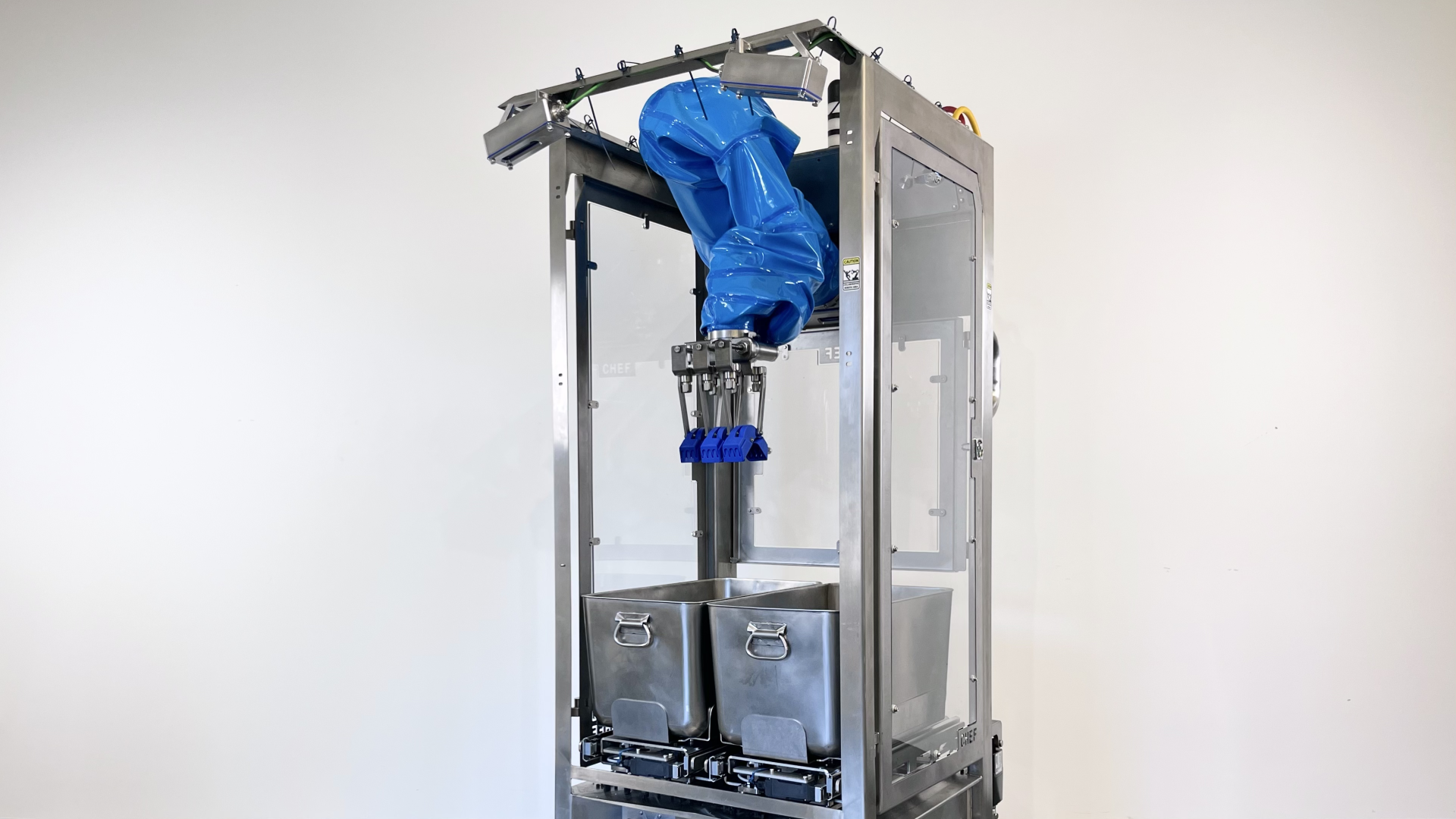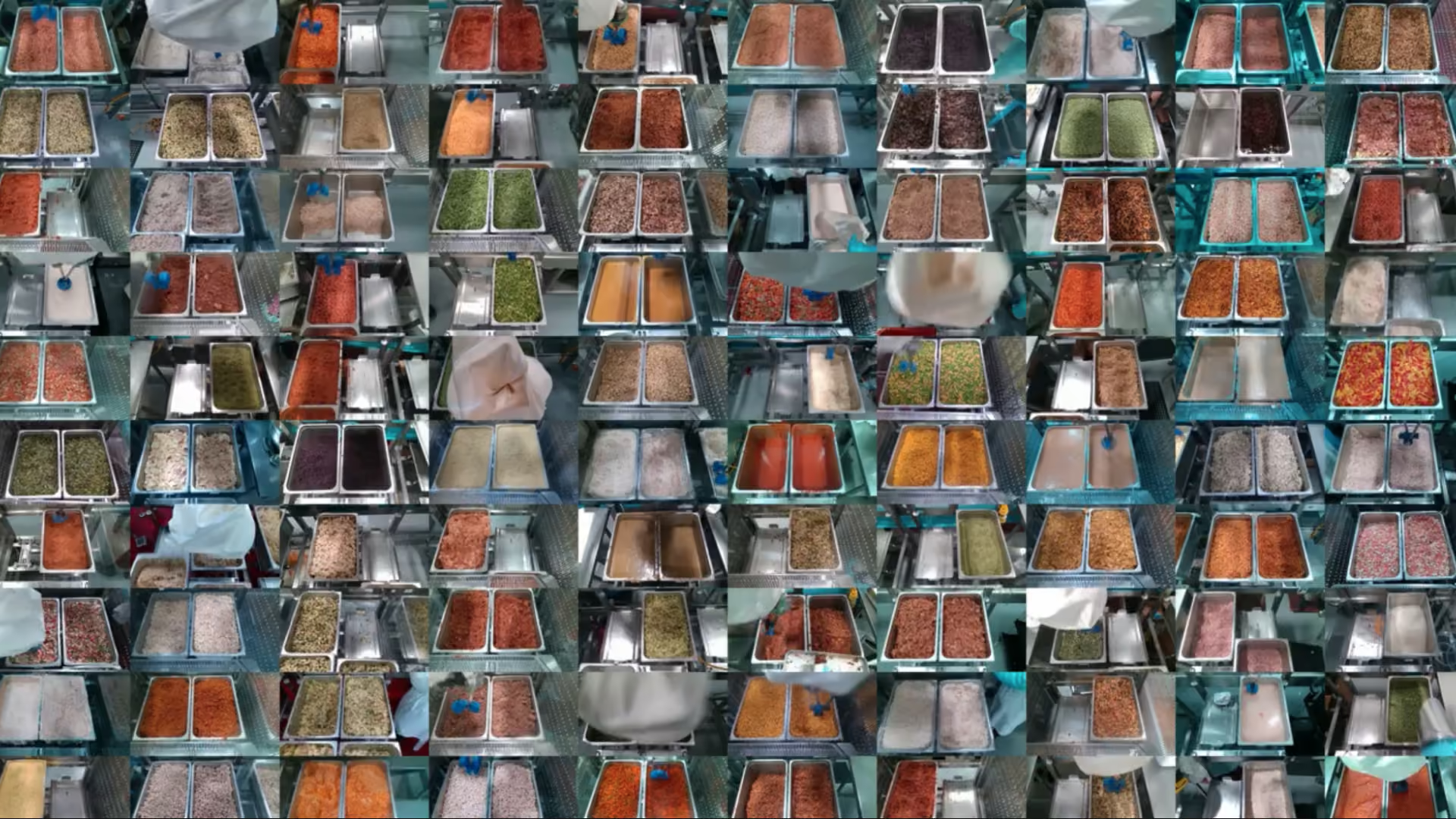
Today, we’re thrilled to announce that Chef robots have completed 100 million servings in production at customer facilities—an order of magnitude more than all other food robotics companies combined. This also means that we have the world’s largest real-world food manipulation dataset and more in-production deformable material training data than any other physical AI company.
As we hit this milestone, we want to thank our customers who’ve trusted us to deploy Chef robots across more than a dozen production facilities in the US, Canada, and Europe. This is also an opportunity to reflect on why production servings are so important in food robotics, how we went from zero to eight zeros, and what happens next.
Building the world’s largest real-world food manipulation dataset
We founded Chef with the conviction that physical AI was opening up the food industry in ways that had never been possible to automate. So we decided to focus on a multi-trillion-dollar market that struggled with a chronic labor shortage due to manual, repetitive tasks: food preparation.
Food robotics before Chef
Physical AI for food was not a new idea. Countless startups had tried to automate food preparation and fallen short, most often due to one fundamental problem: food was too variable and unpredictable for traditional approaches to work. We knew that if we wanted to succeed, we’d have to approach the problem differently.
No training data for food
One of the first things we learned was that simulation, synthetic data, and internet data (the kinds of training data that worked well for autonomous vehicles, warehouse robots, and LLMs) didn’t work well for deformable, highly variable organic materials like food. This meant we would need to train our robots on real-world data. We also knew that data collected in our lab, while useful and even necessary in certain cases, would never be robust enough to serve as our only AI training dataset if we wanted our models to perform well in real production environments at customer sites. This shaped everything about how we built Chef.

Going into production
When most people think about food robotics, they picture fast-casual restaurants: a robot assembling burritos at Chipotle or building salad bowls at Sweetgreen. It’s an intuitive vision, but the wrong place for robots to start. A fast-casual restaurant spends only about four hours a day assembling meals. During those hours, a single worker handles every ingredient on the line. For a robot to replace that worker, it would need to handle a wide range of tasks and have an extremely low bill of materials (BOM) to generate a return on investment.
The crux of the problem was volume. In contrast to fast casual restaurants, a food manufacturing environment has production lines running 16 hours a day, and each worker handles just one to four ingredients per shift. That’s a problem we could actually solve in the early days.
What surprised us was how much of food manufacturing was still being done by hand. The frozen Amy’s Kitchen meal in your freezer, the breakfast sandwich at Starbucks, and the meal on your international flight were all assembled by workers placing each ingredient into trays, one at a time. A labor-intensive process, and the ideal place for robots to help.
The training data flywheel
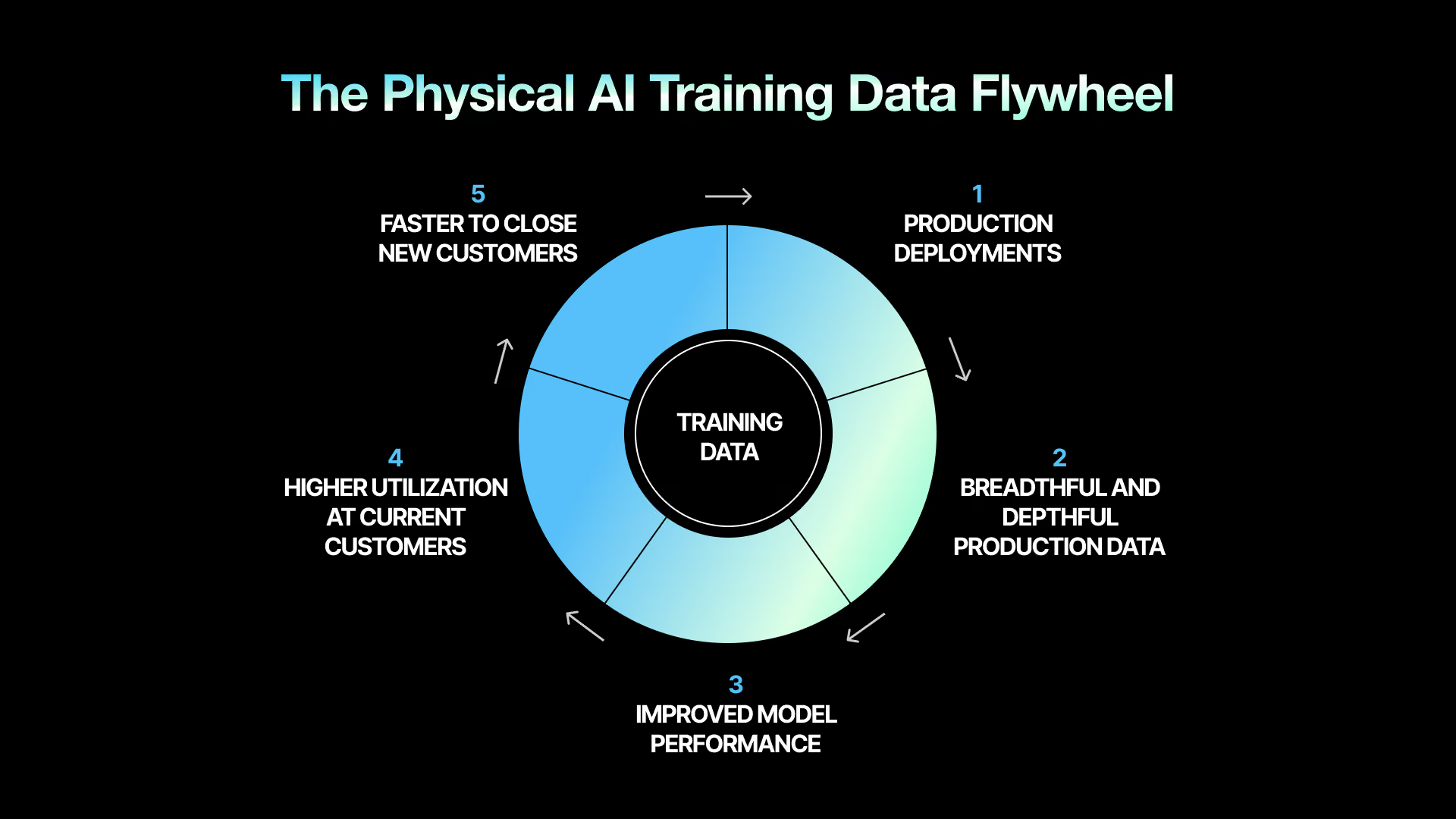
Once we had deployed several Chef robots at our first customer site, training data started to flow in, and the flywheel began to turn. The training data helped us improve our models, enabling our robots to handle more ingredients, trays, and portion sizes. This resulted in even more training data feeding back into the models.
The data was valuable in two ways: depth and breadth. Depth matters because even a single ingredient (e.g., diced chicken) can vary slightly from day to day. It might vary in size, color, texture, and moisture content because it’s organic, hand-prepped, and cooked a little differently each day. Breadth matters because the universe of food ingredients is effectively endless: different types of diced, sliced, or pulled proteins, sauces, curries, cheeses, low-density ingredients like leafy greens, scoopable ingredients vs. discrete items... Each of these represents a different manipulation challenge, with combinations running into the trillions.
As our models improved, customers saw better performance and higher utilization, which justified expanding their deployments. This, in turn, led to (you guessed it) even more training data. We were also able to ramp up new customer sites faster, shortening the time from first installation to full production. The flywheel, while challenging to kick off, was now in full motion.

From 0 to 100 million
We deployed with our first customer, Amy’s Kitchen, in 2022. From there, the milestones came steadily: 1 million servings in 2023, 10 million in early 2024, 25 million later that year, and 50 million last May. We’ve now doubled again in less than a year. This physical AI training dataset—the largest production dataset of deformable materials in the world—will continue to grow. And while we’ve been helping our existing customers improve yield, consistency, and labor productivity, we’re slowly making progress on our quest to improve not only food manufacturing but, eventually, industrial and commercial kitchens as well. Chef’s vision is to deploy physical AI all across North America and Europe, including ghost kitchens, fast-casual restaurants, airline catering, event venues, cruise ships, schools, universities, corporate dining, and hotels.
What we learned along the way
Food robotics is a B2B game
Building a great restaurant or food brand requires culinary excellence and branding expertise. Those skills have nothing to do with building great robots. Early on, we made a deliberate choice to focus on the robots and let our customers focus on what they’re best at. That’s why we partner with food manufacturers rather than trying to become one.
Be hyper-focused on your customers
Only our customers truly know whether our robots are working well in their environment. A simple example: early on, our customers told us to focus on assembly rather than cooking or food prep, because that was where the vast majority of labor actually lived. It was a counterintuitive insight (most people assume cooking is the hard part), one that several food robotics startups missed, to their detriment. Adapting to feedback like this has been instrumental in building strong relationships with our customers and keeping our roadmap pointed in the right direction.
Tackle the hard problems head-on
Robotics is full of difficult problems, and we’ve learned that tackling the hardest problems first certainly pays off. Food is one of the most technically demanding manipulation environments in the physical world. By solving high-variance, deformable food production first, we’ve positioned ourselves as not only the leader in food robotics but also as the category-defining physical AI platform for real-world automation.
Do real things
There’s a lot of hype around physical AI right now, but very few companies are operating in real production environments at scale. We’ve learned more from real-world deployments than from any other part of the business, so much so that every new Chef employee (no matter their team or role) travels to at least one customer site within their first week of joining.
Every serving makes the next one better
The more volume we process across our fleet, the better our models become. This flywheel benefits every customer we work with: Each new ingredient we onboard and each performance improvement we make benefits all Chef customers, who see increased value over time.
What’s next?
With the 100 million milestone under our belt, we’ll keep doing what’s gotten us here: focusing on our customers, improving our robots day by day, releasing new features, adding new ingredients, and keeping the data flywheel going.
If you’re a food manufacturer looking for flexible automation for your production lines, contact us to learn more about Chef.
On to 1 billion!